Who Am I?

Existentialism aside, I think this is something we all ask and it seems like a pretty foundational question. And once it’s answered, we usually live out from the answer.

“If this is who I am, this is how I will act in relationships.” “If these are my gifts, then this is the calling God has for me.” “If this is what I’m feeling, then this is how I should move forward.”

But here’s the problem with that line of thinking:

“If this is how my dreams/ hopes/ desires/ demands are being thwarted, then God must not be for me or just doesn’t even exist.”

Escalated quickly, yes?

I think we have embarked on our search for identity wrong. And we may “know” we are to find our identity in Christ, but do we really by-heart know it?

I was recently introduced to a line of questioning by my small group leader, but this was adapted from Jeff Vanderstelt. Here’s the order in which I usually ask these questions:

  1. Who am I?
  2. So how do I respond?
  3. What did God do for me?
  4. Then who is God?

But how unfortunate is that? My self-view and behavior have no bearing over who God is and what he’s done!

For example, when I was once passed over for a professional role I had thrown my hat in the ring for, I was trying to re-examine some goals. Who was I? I was a failure and probably not meant to be where God had placed me. How was I to respond? Hide, of course! I had failed and been rejected and could not let people know I was a fraud! What did God do? He had placed me here to reveal my inadequacy. Then who is God? He’s trying to teach me a lesson about not feeling too confident in my abilities.

…There’s a lie in there somewhere. Maybe more than one.

If I truly want to understand who I am, I need to flip my understanding of myself on its head. This often means flipping my frame of understanding around:

  1. Who is God?
  2. What did God do for me?
  3. So how do I respond?
  4. Then who am I?

When these questions are answered in the proper order, I am able to live out of the story of the gospel, rather than the story of selfishness I am trying to tell on my own. Living out of the gospel gives me and outward and upward perspective, rather than trying to satisfy my inward longings.

Let’s look at that same scenario:

Who is God? He is my father and creator. What has he done for me? He as saved me and covered me in his righteousness because of his great love for me. How to I respond? I trust that what he has for me is best in both success and failure. Then who am I? I am dearly loved and no good thing has been withheld from me.

With these questions in a proper order, my view of God and view of self are also ordered properly. From there, I can respond out of truth and walk forward in faith despite the hurt of my circumstances.

Which set of questions are we living out of and how is that effecting our friendships, families, marriages, vocations, and even our self-talk?

The first question may be, “Who are you?”, but the second question must be, “How are you going to answer that?”

Something Small, Something Simple

I shared a couple weeks back about feeling cranky with my faith. Some of this stems from some things in my church that may not be to my personal preference. Most of it stems from a personal pursuit of God that was too narrow and self-focused.

It’s easy for my heart to go from discerning and deep-thinking to cynical and critical, and I was seeing evidence of this in my relationship with God. So much felt like thrill-seeking—the next conference, the next bible study, the next coffee with a mentor—that would bring the insight, depth, or change I was aching for. But God is not a spiritual crack dealer.

God is found in the simple and small—the word, prayer, and community. And so a journey to find personal liturgy began.

…And slowly crashed and burned.

Reading James K.A. Smith’s You Are What You Love was insightful, bringing words to feelings and longings I’ve held in my faith life for so long. The book is a call back to small daily practices that realign us with God’s story. It’s a call to look at our habits and what they point our hearts to and retraining our habits to point to the gospel—what we truly want to love. It’s looking for liturgy in the everyday.

Thing is, the book was on the philosophy of this more than the practice. So what do daily liturgies look like for a single girl in an evangelical church?

Honestly, I still don’t know. What I do know is this:

I operate better under structure, though I try to avoid it to keep my autonomy

Autonomy is not biblical, and that is something I’ve had to examine and accept. Having a structure to my days and weeks helps me to function better and live healthier. Having habits to look to from the outset keeps me from feeling lost or purposeless. It instead brings focus and shape.

I love my job and the flexibility it brings, but I also acknowledge that it is an opportunity to steward my time and habits well and I want to do so in a way that welcomes community. Not in a way that hordes my autonomy.

Prayer is not passive, but is, in fact, the most powerful thing we can do

Prayer was something I did in a prayer journal when I had plenty of time to write out long prayers by hand in a prayer journal. So guess what was the first thing to go out the window when life got busy?

So, yes, I still love those extended times of prayer, but I’ve also found that I want to form habits that allow me to pray without ceasing. When a friend I haven’t talked to in a while comes to mind, I pray for them. When something on the news stirs my hear to be anxious, I pray about it. When I’m at a loss, I pray.

Not all the time, but enough that this is becoming second nature, rather than just some new thing I’ll try for three days and forget about.

The church is built when the body of Christ is down on it’s knees

Yes, spiritual formation can happen in big arenas with flashy speakers. But lasting change and discipleship happens in the quiet moments alone, between the word and prayer.

I can think I know what is right for myself, or the church, or society at large, but I am so often wrong. Starting my day with prayer and time in the bible rather than the news or my email inbox brings a different rhythm to my days.

I have started reading Seeking God’s Face each morning and am grateful for the reminder of who God is and what his heart is for every morning. The book pairs a psalm and passage of scripture with prayer prompts and excerpts from various books of prayer. It also guides you through the seasons of the Christian year—something very new to this baptist girl.

This habit has been refreshing and grounding.

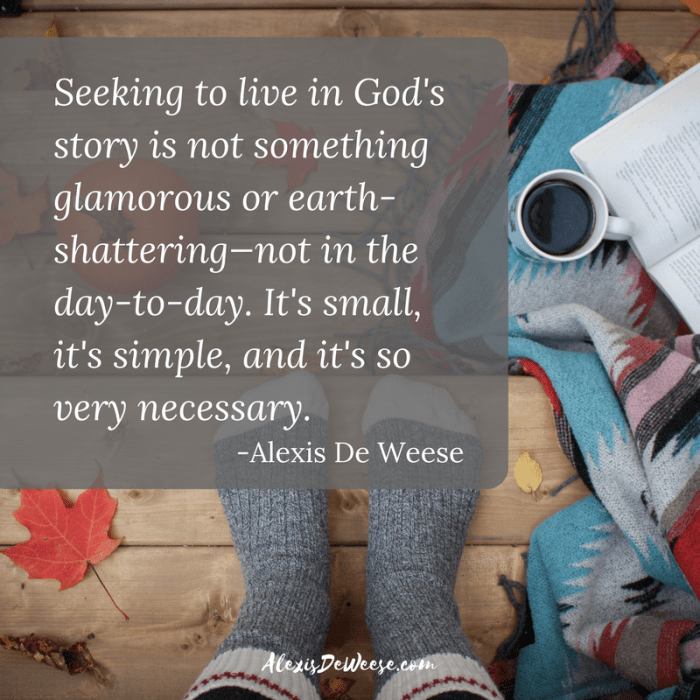
I’ve found that seeking to live in God’s story is not something glamorous or earth-shattering—not in the day-to-day. It’s small, it’s simple, and it’s so very necessary.

How are you seeking small and simple habits to point you back to God’s story?


Marriage, Idolatry, And The Church

I am so thankful that so many of you reading this want to be part of the dialogue about marriage, singleness, and the church. I also love that your approach–and the approach I try to have–is that of all-of-us-in-this-together mentality rather than us-versus-them. Your responses are encouraging, enlightening, and just plain fun to interact with.

After my last post on marriage and singleness went live, I received a really thoughtful response asking for clarification on a statement I made and a great conversation emerged. I’d love to bring that conversation to our community at large today.

I stated and still stand behind the statement that the church (especially the evangelical side of the body) tends to idolize marriage. But how do I see this? Here are some of the thoughts that came out of this great dialogue.

Once upon a time, I was very passionately involved in the purity culture that was so active in the late nineties and early two thousands. I had kissed dating good bye and embraced authentic femininity with Jesus as my prince charming. (And I have lots of thoughts about that time in my life, but that’s a different blog post.) There was so much teaching I subjected myself to that were, frankly, lies verging on spiritual abuse.

We were taught—and many are still taught—that we need to be sexually pure for the sake of our future spouse—not for the sake of godliness or obedience. But what if there is no spouse ahead? Then what was the point?

I remember banking on the words of a popular purity author of the time that essentially amounted to “if you pursue a relationship with God and do everything you’re supposed to as a good Christian girl and you want a marriage hard enough, he will bring that to you.” But is that not just a slanted version of a prosperity gospel? This was based off of the Psalm saying that God will bring us the desires of our hearts. But what if he won’t give us the thing we desire, but instead redeemed desires?

So often the dialogue for young people regarding a future of marriage is that it is the only and expected option. This is what I mean by the idolizing of marriage. It is the assumption that it happens for everyone and if it does not, something is wrong.

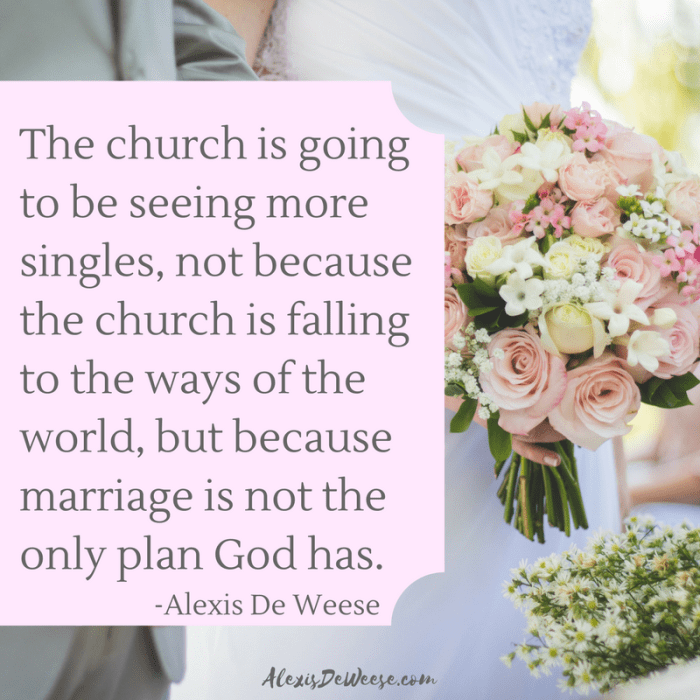
The stats a single friend has shared—and according to a Barna study are correct—is that there are twice as many Christian young women in the world than Christian young men. If we are supposed to seek to be equally yoked, the church is going to be seeing more singles, not because the church is falling to the ways of the world, but because marriage is not the only plan God has.

In an unbroken world, yes, I think everyone would find their person, but in our broken world, God draws together so many of us with different stories to make up his body. I think we need to acknowledge this possibility and diversity of God’s plan earlier than we have been with our young people—from jr. high and high schoolers as well as those in adulthood.

Here is a question my friend asked, that I’d love for you to weigh in on: how can these two groups—married and single—not just coexist, but thrive together, and benefit one another? Please weigh in in the comments below!

My friend, Gina Dalfanzo addresses much of this in her fabulous book, One By One. I highly recommend you pick up a copy if this discussion interests you.

I’m Cranky And I Know It

If I were to describe my relationship with faith and the church in this season of my life, I think there is an overarching theme that would emerge: I’m cranky.

There are parts of what I’ve grown up with that feel like a sweater I’ve grown out of—the hem doesn’t meet my jeans any longer and the sleeves are tight around my upper arms and it just feels uncomfortable. I read a book on spiritual formation for women and I wonder why so much of it is based on feelings and why it had to be directed at women instead of all of us. I leave a church service feeling grippy about the amount of first-person-personal-pronouns used in so many Christian songs today. I cross my arms feeling like I will never be respected or taken seriously in an evangelical community unless I am married with children.

Mostly, I notice my brokenness in all of this complaining and discontent.

A cycle of frustration and guilt, frustration and guilt, frustration and guilt has marked my days and I have had trouble reconciling the tension. So many prayers asking for contentment, or better attitudes, or anything to resolve the itchy, too-tight feeling I feel in my faith communities. Because, let’s be honest, I am the common denominator in these spheres.

It wasn’t until listening to two friends talk through one’s frustrating family situation that I began to find some hope.

“I’m just becoming so aware of my brokenness in all of this,” my one friend said, a little teary.

“But just think,” our friend responded, “He loves you too much to not make you aware of this. He wants you to know this is in you, and he’s singing over you with grace in this struggle. He won’t leave you here.”

I almost started sobbing right there. Because I felt this—I hadn’t known it before that moment, but this was what I had been aching for.

God loves us so much that he has covered us in his own righteousness that we can come before the Father without fear. And how much more does he loves us that he takes us just as we are, but also steps in to heal our broken places.

He is not looking for me to heal my broken, cranky places. Of that, I am incapable. He is making me more aware of them so that I bring them to him. To sit with him, seeking more of him. To behold over behave.

My purpose is not to fix the church. That is for God to do. I am part of the church—a very broken part at that. My purpose is to sit and let him work on me, surrendering how I think things should be—how I think I should be. To let him sing over me in grace so that I may walk out into the world with that same grace to give.

He confronts us with our brokenness not to shame us into submission. He wades into our broken places to demonstrate his grace and sing over us with love. It’s through grace and love that our broken places are made whole.

For the Sake of My Neighbor

Every morning I receive an email that is essentially SparkNotes for the news. This has been a really helpful tool for keeping up with current events, but for the past year, it has also been really helpful in putting me in a state of lament before I even leave bed.

It’s so easy to be bogged down by how broken our world is—natural disasters raging in all the corners of the globe, corruption of power permeating our politics and culture, nasty, thoughtless words splashed across social media. It makes me sad. It makes me tired.

But here is what I am holding on to tighter and tighter these days: I am not a citizen of this world. I am a citizen of the kingdom.

No, this doesn’t fix anything in the far reaches of the world. No, this does not bring relief to the suffering brought to light in my inbox every morning. But here is what knowing that does:

Being a citizen of the kingdom of God brings to light what I can do in my sphere of influence. It reminds me that peace does not start out in Spain or Iraq—it starts in my home. It allows me to extend grace to an acquaintance online who’s words may seem narrow to me, and instead gives me the opportunity to pray for them and perhaps ask a question out of love. It calls for me to encourage, challenge, and care about what is happening in the spaces I frequent with the people who mean something to me.

Joining the kingdom allows me to think on my neighbor in ways that help him flourish. It gives me eyes to see those who are other than me and find ways to love them in a manner that helps and doesn’t harm. It allows me to experience compassion and forgiveness so that I may then go out and extend it.

Yes, these days feel dark and hope sometimes far off. Oh, do I feel that, friend. But we have been placed where we are for a reason! We interact with the same people on a regular basis. We frequent the same places routinely. These places are our mission fields! These people are the ones we are called to serve with grace and compassion! Sometimes this means listening—really listening—to those we don’t agree with. Sometimes this looks like donating household items you aren’t using for refugees relocating to your area. Sometimes this is as simple as dropping to your knees and praying for your community.

Whatever it looks like, let’s do it. Let’s take our place in the kingdom.

Participating in the kingdom feels small and ordinary and sometimes not enough, but it is what I am called to and a way I can actually make a difference. And the same is true of you.

So where will you bring peace, hope, and love today?

If you’d like to read more on this concept, I highly recommend You are What You Love by James K.A. Smith or Practices of Love: Spiritual Disciplines for the Life of the World by Kyle David Bennet.

Sweating Like A Single in a Marriage Series

When my church announced they would be kicking off the fall with a sermon series on marriage, yes, I rolled my eyes.

Because “Don’t we talk about marriage enough?” and “Isn’t the Church idolizing marriage?” And perhaps the answer to these questions is yes, but I was opporating out of a blind spot in my judgment. And isn’t that always the case with our sin?

One of our pastors who has been a long suffering mentor of mine told me he would be using a recent blog post of mine in his first sermon in the series, which was touching and humbling and blah, blah, blah.

Yeah, I was more concerned that my writing was being shared for the sake of showing all those married people that we’re here too! Singleness is just as relevant! (Hear the bitter demand for retribution?)

We’re living in a very devisive landscape these days. You can’t get on any social media site without reading something that demands you pick a side (preferably their own).

We stand on our soapboxes trying to out-yell one another into submitting to our own brand of justice. The noise is so loud and our justification so blinding that we don’t see the man on the soapbox across from us as human any longer. We just see him as wrong.

But scripture (not Abraham Lincoln!) tells us that a house divided cannot stand.

Here I was last Sunday waiting to hear that I as a single was a valued and necessary part of my community and I was annoyed when there was no application that applied to me specifically. I was too caught up in the us-and-them mentality that permeates my weekdays that I brought that into Sunday. I was operating out of defensiveness after not getting my way rather than thinking of my neighbor.

Jesus’ ministry was about laying down his right for the sake of the other and that is what he calls us to. Yes, the Church may idolize marriage, but trying to swing the pendulum to singleness helps no one.

“There is no longer Jew or Gentile, slave or free, male and female. For you are all one in Christ Jesus.” (If Paul was writing not to Galatia, but to the church in in America, I think he’d include “married or single, right or left”.)

Perhaps I need to get off my soapbox and interact with those I disagree with out of compassion rather than judgement. Perhaps I should seek unity and love before I seek being right only. This is the freedom my salvation bought.

We mourn division in the church, but what are we actually doing to heal it? Because if we think just screaming what we’re right about until those who disagree change their minds, that gap just continues to widen. What does it look like for us to climb down from being justified and give up my right in order to love my neighbor well?

Leading a Romantic Life When You’re not in a Romance

One of the pleasures of seeking contentment in the season I’m in has been pursuing a romantic life over a life filled with romance.

What does that even mean? Great question!

My evenings are not filled with dates very often, but that does not mean that I need to wait to experience beautiful and exciting things—a thought-trap I think we can fall into when waiting for romantic love.

That’s a lie! Why wait to experience the beauty life has to offer until one is in a relationship?

I cannot tell you the joy I have found in visiting the local botanical gardens with just myself and a journal, in planning vacations with dear friends, in sitting in my favorite hotel lobby with a good book and cup of tea.

I live in a city that begs to be explored and while some of that exploration would be fun to do as a date night, why should I miss out when I find myself alone? Why should any of us.

Pursuing a romantic life means making time for the things that bring me pleasure. It means stopping to enjoy created beauty. It’s exploring the small things that make up a life that might otherwise go unnoticed.

Here’s what this looks like for me:

    • Traveling Europe alongside close friends.
    • Spending an evening in with nothing to do but drink a cup of tea and listen to the poetry of a new record.
    • Taking myself on a coffee date.
    • Doing nothing but read for an entire weekend.
    • Bringing a journal to the local botanical gardens for a morning of prayer and reflection.
    • Driving hours just to go to see my favorite band play in concert.
    • Re-reading my favorite book from childhood each summer
    • Wearing heels and the brightest red lipstick I can find because it makes me feel like an old Hollywood actress.
    • Making last minute plans with a friend to talk about the real stuff over wine.

And it’s not just enjoying what I know I like, but pushing myself to experience the new and different, and maybe slightly uncomfortable. I have plans to take myself out to dinner. I’m starting to dream up a trip to take by myself.

Living a romantic life is participating, not in the life you dreamed of, but the pretty-damn-beautiful life you’ve been gifted. It’s taking note of the glorious and grand in the midst of the minute and mundane.

This has been my adventure and I want to hear about yours. How are you pursuing a romantic life?

Heartburn and Heart Yearn


A couple months ago, I was preparing to leave on a writer’s retreat with some dear friends—a gathering that has become a beloved tradition at the start of every summer.

I ran to the grocery store to pick up the food items I was bringing for the weekend and I took a call from a friend while in the store. My shopping list was on my phone, but I figured I could freewheel it.

I had a great conversation with my friend, ran trough the check out with my items, took my coupons from the cashier (excited I had earned two instead of just one!) and left for home.

Half-way through the drive I realized I had forgotten the chicken breast—a key ingredient in grilled chicken. I decided not to turn around—chances were I would have to return to the store again before I was done packing.

Putting away the groceries, I found my not-one-but-two coupons at the bottom of a bag and was disappointed to find that they were both for heartburn medication. Not the buy-one-get-one ice cream coupon a bunch of friends had been talking about getting. I thought it was sadly funny and continued to prepare for the weekend.

After dinner, I ran to the store once more to pick up travel-sized soap and chicken breast. Again I managed to forget the chicken breast.

But guess what I came home with? A third heartburn medication coupon! Now it was just getting cruel. I have not yet had to experience the joy of heartburn. And, for the most part, the coupons from this store are based on your purchases…so what was in this soap that causes heartburn?!

Finally at eleven o’clock that night, I went to the store a third time along with a friend. This time I left with the chicken breast and my friend left with a buy-one-get-one ice cream coupon. Guess what coupon I got?

Yeah. 30% off heartburn medication.

And I had to laugh thinking back on this the other day because how much of my life is like this?

I didn’t go to the store to get coupons for heartburn medication or pints of ice cream for that matter. I went for chicken!

There are so many season in life where I have looked at what others are getting, upset with what I’ve been given all while missing the entire point. There are things that my heart wants that it is not getting, but in the midst of that, am I pursuing what my heart needs? (And no, I don’t mean chicken breasts!)

I confess that I loose site of the kingdom so often, caught up in hustling, achieving, and competing. Trying to have it all so often becomes the name of my game rather than slowing down and taking in what I really need: Jesus.

But once I have what I really need, what I want starts to change. What I was striving for starts to matter less and the circumstances I’m not pleased about become secondary. When my heart yearn is aligned where it needs to be, my longings begin to reflect the kingdom in proper ways.

The Metaphor and Blood-and-Guts Reality


For the last nine months I’ve been wrestling over the question, “If marriage never happens for me, will I be okay?

And the answer varies day-to-day, I’ll be honest. But it struck me the other morning in a big way. I was lamenting the fact that I may never experience that kind of intimacy and then a new thought emerged. Maybe I was very wrong.

We seem forget that marriage is just the metaphor, reflecting a larger, universal reality.

Marriage is supposed to be a picture of Christ and his Church. But somewhere along the line, marriage became the reality—the concrete realness of things.

But marriage has become less permanent and the pretty picture seems to be fading, and here’s the problem with that:

Marriage is just the picture. It was never intended to be what Christ and his bride reflect. It is instead the reflection, the lesser figuration of something greater—something blood-and-guts real.

I experience a beautiful relationship daily, if I agree to enter into the fray and the messiness. I experience the heartache of surrender—of not getting my way, of discovering I’m wrong, of giving up my own dreams for the dreams of another. I experience that other giving himself up for my sake—sometimes with intensity, sometimes with a distance I try to manifest.

I walk the tension of trying to do an unbroken thing despite my unavoidable brokenness. I know the pain of having the one who claims to love me most let me walk through more darkness than I thought possible. I experience the shame and yet overwhelming joy of sitting beside the one I’ve hurt so deeply and having him still look me in the eye and not look away—to extend mercy.

There has been an undying commitment made to me—one with no escape hatch. And despite the temptations to fulfill my needs elsewhere, I have committed to staying.

For better or worse. For richer or poorer. In sickness and in health. As long as I live until death do we finally meet face-to-face.

I have never been married, yet I have experienced all of this.

Because marriage is only the metaphor. The real, ironically concrete, flesh-and-bone, blood-and-guts, no-way-out kind of relationship so many of us crave—within marriage or without— is that between Christ and his Church.

I don’t need a husband to experience the challenge and growth of intimate, lock-the-door-and-throw-away-the-key kind of commitment. That was given to me upon the cross just as it has been extended to you.

So we can rest assured that what hasn’t been granted us in marriage—or what we perhaps feel our marriage is lacking—is still ours. It’s ours in relationship with Christ.

A Prayer for Now

I work in social media, so I’ve seen how this goes, but I can’t not say something. My heart is too broken not to.

See, I don’t like getting political on the internet because I have watched time and time again as people forget that there is a very real human being at the other end of their rage-ladened comments. But this weekend, the rage went beyond the internet and out into the streets in a manner I cannot abide. As this reached far beyond political, I can also no longer abide being silent.

To see scripture references scrawled on signs in the name of hate toward fellow image-bearers in such an ugly, appalling, and shameless way makes me sick. And angry. And so homesick it hurts.

Because what happened this weekend was evil.

There was nothing justified in the action of those white supremacists—because we call ugly hateful things what they are.

I’ve watched a lot of broking things go down because the church remained silent and right now I can’t be silent.

But I have no words, just a heavy feeling of lament. My sphere of influence is small, but I’m committed not to just shed a tear, shrug a shoulder, and move on. So I sit with the tension here.

In doing some work over the weekend, I ran across some beautiful words from Martin Luther King, Jr. I think we all need:

The church must be reminded that it is not the master or the servant of the state, but rather the conscience of the state. It must be the guide and the critic of the state, and never its tool.
If the church does not recapture its prophetic zeal, it will become an irrelevant social club without moral or spiritual authority. If the church does not participate actively in the struggle for peace and for economic and racial justice, it will forfeit the loyalty of millions and cause men everywhere to say that it has atrophied its will.
But if the church will free itself from the shackles of a deadening status quo, and, recovering its great historic mission, will speak and act fearlessly and insistently in terms of justice and peace, it will enkindle the imagination of mankind and fire the souls of men, imbuing them with a glowing and ardent love for truth, justice, and peace.
—Martin Luther King Jr., “A Knock at Midnight”

I am praying today that our imaginations are realigned with God’s. I’m praying that we remember that courage comes after obedience. I’m praying we remember that no matter a person’s race, religion, or political bent, we are image-bearers—and that is so beautiful.

Perfect love casts out fear. May this stir us closer toward perfect love.

If you want to take a next step with me, pick up a copy of Ken Wytsma’s latest release The Myth of Equality. His thoughts are so relevant and needed in these dark times.

We are never without hope. We are the salt of the earth and a light on a hill. Truth can never be drowned out and love never fails—even in the face of such blatant despicable hate. I stand for my fellow image-bearers.