Blog

Book Review: Fiercehearted

I work in publishing and I love it. But if someone was to ask me what I disliked about the industry I’m in, I would complain about the quality of content being produced for women.

It’s a trend within Christian literature—particularly that targeted at a female audience—that’s pushed more of a feelings-bases theology than I’m comfortable with. I’m not going to name authors or dig into that frustration here.

Instead, I want to talk about a different voice in the conversation for women that has brought me a little hope this month.

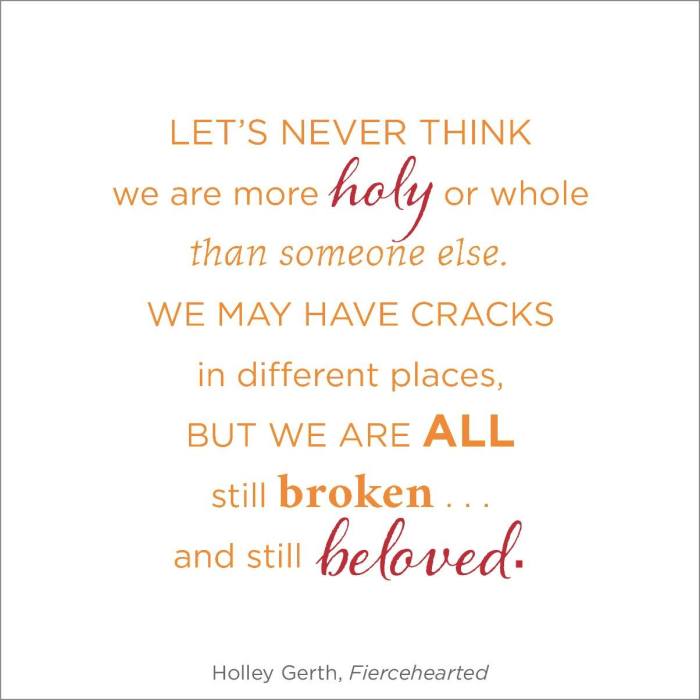
Holley Gerth’s latest, Fiercehearted explores the wonder, pain, beauty, and brokenness that makes up the Christian walk of a woman. In short, personal—sometimes deeply so—essays, Gerth explores what it means to lean fully into the call to be a woman of God.

I’ll be honest, I was a little hesitant to pick up another book on faith targeted solely to women, but when I read the back cover copy, I had to be in.

In a season in my life where I feel tired, cranky, and like I just don’t fit it, it takes a little more courage to step beyond the pages of my Bible to live out what the words say.

For example, the author describes her struggle to have children and her journey to surrender that longing. I resonated deeply with her struggle to feel like her life needed to fit a certain mold. As I struggle to surrender my own longings, it was a comfort to hear of God’s faithfulness in her story, seeing how he met her in such an unconventional and beautiful way.

I would recommend Fiercehearted for those feeling worn by the season they currently find themselves in, those struggling with significance, and those looking for short bits of encouragement in a dark season. I think Gerth’s readers will find her relatable, honest, and wise.

Marriage, Idolatry, And The Church

I am so thankful that so many of you reading this want to be part of the dialogue about marriage, singleness, and the church. I also love that your approach–and the approach I try to have–is that of all-of-us-in-this-together mentality rather than us-versus-them. Your responses are encouraging, enlightening, and just plain fun to interact with.

After my last post on marriage and singleness went live, I received a really thoughtful response asking for clarification on a statement I made and a great conversation emerged. I’d love to bring that conversation to our community at large today.

I stated and still stand behind the statement that the church (especially the evangelical side of the body) tends to idolize marriage. But how do I see this? Here are some of the thoughts that came out of this great dialogue.

Once upon a time, I was very passionately involved in the purity culture that was so active in the late nineties and early two thousands. I had kissed dating good bye and embraced authentic femininity with Jesus as my prince charming. (And I have lots of thoughts about that time in my life, but that’s a different blog post.) There was so much teaching I subjected myself to that were, frankly, lies verging on spiritual abuse.

We were taught—and many are still taught—that we need to be sexually pure for the sake of our future spouse—not for the sake of godliness or obedience. But what if there is no spouse ahead? Then what was the point?

I remember banking on the words of a popular purity author of the time that essentially amounted to “if you pursue a relationship with God and do everything you’re supposed to as a good Christian girl and you want a marriage hard enough, he will bring that to you.” But is that not just a slanted version of a prosperity gospel? This was based off of the Psalm saying that God will bring us the desires of our hearts. But what if he won’t give us the thing we desire, but instead redeemed desires?

So often the dialogue for young people regarding a future of marriage is that it is the only and expected option. This is what I mean by the idolizing of marriage. It is the assumption that it happens for everyone and if it does not, something is wrong.

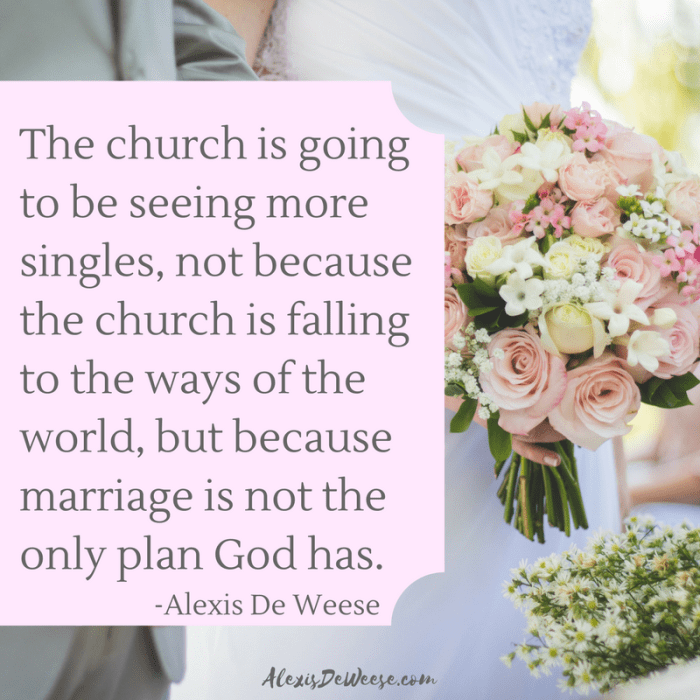
The stats a single friend has shared—and according to a Barna study are correct—is that there are twice as many Christian young women in the world than Christian young men. If we are supposed to seek to be equally yoked, the church is going to be seeing more singles, not because the church is falling to the ways of the world, but because marriage is not the only plan God has.

In an unbroken world, yes, I think everyone would find their person, but in our broken world, God draws together so many of us with different stories to make up his body. I think we need to acknowledge this possibility and diversity of God’s plan earlier than we have been with our young people—from jr. high and high schoolers as well as those in adulthood.

Here is a question my friend asked, that I’d love for you to weigh in on: how can these two groups—married and single—not just coexist, but thrive together, and benefit one another? Please weigh in in the comments below!

My friend, Gina Dalfanzo addresses much of this in her fabulous book, One By One. I highly recommend you pick up a copy if this discussion interests you.

Book Review: Warcross

It has been my goal this fall to get more in touch with Young Adult literature since that is the sphere in which I would ultimately like to write.

I recently subscribed to Uppercast Box (which is AWESOME, by they way) and the first book to come my way was Warcross by Maria Lu.

Warcross takes place in a very near future where we have discarded social media and video games for the brilliant and revolutionary replacement of virtual reality—namely, the game Warcross. It’s in this sphere that we meet Emika Chin—a talented hacker and gamer who has been dealt a bad hand and a criminal record. The annual Warcross games (think the Olympics mixed with the Quidditch World Cup) are coming up and Emika plans to watch, despite the eviction notices showing up on her door and her meager income from bounty hunting not taking care of her debts. She performs a hack during the opening games that launches her into the limelight and catching the attention of her hero and Warcross creator Hideo Tanaka.

Sound like fun?

Here’s why I enjoyed it:

  • Diverse cast: the characters of the book span numerous cultures and ethnicities—something that you didn’t see very often ten years ago. I loved learning about Japanese cultures and relating with characters that didn’t look like me. I was also touched thinking of the young women who did connect with these characters because they looked like them. I love that!
  • Smart, savvy female protagonist: Emika is resourceful, flawed, vulnerable, and strong. I loved how Lu pulled back the layers of her main character in a way that was intriguing and relatable. Our culture demands strong female leads, but we are often given women who do not feel or are just fighting machines. Emika can handle her own battles, but isn’t afraid to lean into a potential romance, or feel loss. She was so different from me, but I connected with her immediately.
  • Dilemma not one of love, but morality: I won’t spoil the big conflict of the novel, but I will say that I really respected that it did not center around the romance of the story, but instead the integrity of the characters. This was fresh and very discussable.

I would recommend Warcross to those who enjoyed the Hunger Games or Divergent series—a tough female lead who actually has a heart and discernible skills. I also would recommend this to gamers who love to read. I have it on good authority that Lu threw in all kinds of great gaming easter eggs that were completely lost on me just because that’s not part of my world.

I cannot wait to see where the sequel leads and which path Emika chooses to take.

I’m Cranky And I Know It

If I were to describe my relationship with faith and the church in this season of my life, I think there is an overarching theme that would emerge: I’m cranky.

There are parts of what I’ve grown up with that feel like a sweater I’ve grown out of—the hem doesn’t meet my jeans any longer and the sleeves are tight around my upper arms and it just feels uncomfortable. I read a book on spiritual formation for women and I wonder why so much of it is based on feelings and why it had to be directed at women instead of all of us. I leave a church service feeling grippy about the amount of first-person-personal-pronouns used in so many Christian songs today. I cross my arms feeling like I will never be respected or taken seriously in an evangelical community unless I am married with children.

Mostly, I notice my brokenness in all of this complaining and discontent.

A cycle of frustration and guilt, frustration and guilt, frustration and guilt has marked my days and I have had trouble reconciling the tension. So many prayers asking for contentment, or better attitudes, or anything to resolve the itchy, too-tight feeling I feel in my faith communities. Because, let’s be honest, I am the common denominator in these spheres.

It wasn’t until listening to two friends talk through one’s frustrating family situation that I began to find some hope.

“I’m just becoming so aware of my brokenness in all of this,” my one friend said, a little teary.

“But just think,” our friend responded, “He loves you too much to not make you aware of this. He wants you to know this is in you, and he’s singing over you with grace in this struggle. He won’t leave you here.”

I almost started sobbing right there. Because I felt this—I hadn’t known it before that moment, but this was what I had been aching for.

God loves us so much that he has covered us in his own righteousness that we can come before the Father without fear. And how much more does he loves us that he takes us just as we are, but also steps in to heal our broken places.

He is not looking for me to heal my broken, cranky places. Of that, I am incapable. He is making me more aware of them so that I bring them to him. To sit with him, seeking more of him. To behold over behave.

My purpose is not to fix the church. That is for God to do. I am part of the church—a very broken part at that. My purpose is to sit and let him work on me, surrendering how I think things should be—how I think I should be. To let him sing over me in grace so that I may walk out into the world with that same grace to give.

He confronts us with our brokenness not to shame us into submission. He wades into our broken places to demonstrate his grace and sing over us with love. It’s through grace and love that our broken places are made whole.

For the Sake of My Neighbor

Every morning I receive an email that is essentially SparkNotes for the news. This has been a really helpful tool for keeping up with current events, but for the past year, it has also been really helpful in putting me in a state of lament before I even leave bed.

It’s so easy to be bogged down by how broken our world is—natural disasters raging in all the corners of the globe, corruption of power permeating our politics and culture, nasty, thoughtless words splashed across social media. It makes me sad. It makes me tired.

But here is what I am holding on to tighter and tighter these days: I am not a citizen of this world. I am a citizen of the kingdom.

No, this doesn’t fix anything in the far reaches of the world. No, this does not bring relief to the suffering brought to light in my inbox every morning. But here is what knowing that does:

Being a citizen of the kingdom of God brings to light what I can do in my sphere of influence. It reminds me that peace does not start out in Spain or Iraq—it starts in my home. It allows me to extend grace to an acquaintance online who’s words may seem narrow to me, and instead gives me the opportunity to pray for them and perhaps ask a question out of love. It calls for me to encourage, challenge, and care about what is happening in the spaces I frequent with the people who mean something to me.

Joining the kingdom allows me to think on my neighbor in ways that help him flourish. It gives me eyes to see those who are other than me and find ways to love them in a manner that helps and doesn’t harm. It allows me to experience compassion and forgiveness so that I may then go out and extend it.

Yes, these days feel dark and hope sometimes far off. Oh, do I feel that, friend. But we have been placed where we are for a reason! We interact with the same people on a regular basis. We frequent the same places routinely. These places are our mission fields! These people are the ones we are called to serve with grace and compassion! Sometimes this means listening—really listening—to those we don’t agree with. Sometimes this looks like donating household items you aren’t using for refugees relocating to your area. Sometimes this is as simple as dropping to your knees and praying for your community.

Whatever it looks like, let’s do it. Let’s take our place in the kingdom.

Participating in the kingdom feels small and ordinary and sometimes not enough, but it is what I am called to and a way I can actually make a difference. And the same is true of you.

So where will you bring peace, hope, and love today?

If you’d like to read more on this concept, I highly recommend You are What You Love by James K.A. Smith or Practices of Love: Spiritual Disciplines for the Life of the World by Kyle David Bennet.

A Blessing for Writers

I spent my weekend at the Breathe Christian Writers Conferenceone of my favorite things EVER. I had the immense privilege of writing a blessing and prayer for this community that has given me so much and I just wanted to share it with you in lieu of a blog post today. I think this is something that can bless all creatives out there.

Last year we closed the conference with a statement by James Scott Bell:
“We are the storytellers. We bring the light.”

This year has proven time and time again that we are still called to this. These are dark and divisive times where the light is more desperately needed than ever before.

Each of us was called to this noble task ahead. How do we know we are called? We have been saved. And we are also called to share what we have been graciously given.

To adapt the words of Alvin Plantinga for the sake of us writers:
“We who are Christians and propose to be writers must not rest content with being writers who happen, incidentally to be Christians; we must strive to be Christian writers. We must therefore pursue our projects with integrity, independence, and Christian boldness.”

This is the charge I give to you, writers!

May we continue to encourage one another onward:

To create with integrity—knowing that to create costs, but that we have been called to create nonetheless.

To create with independence—knowing God has given us work that only we can do with the experiences and burdens he has bestowed to each of us.

But most of all to create with Christian boldness—to know that whether we write for an audience of believers or not, or even an audience of one, we have not been given a spirit of timidity, but one of courage.

We go out from this place to tell the truth in our stories, poems, songs, essays, scripts, letters, emails, even our ephemeral social media musings. We go out to invite the world to sit at the feet of our God and listen.

All great liturgies end with a sending, so may I pray with you to send you out?


Lord,

I thank you for this gathering where we may join together and affirm the gifts and words you have given to us. You have placed each and every person in these seats with great purpose and I thank you for the call you have placed on these lives.

May these souls leave here encouraged, connected to one another and even more deeply connected with you.

As we journey from here, do not let us shy away from the words you have given us to write, but instead let us push past resistance and sit down to our desks, our notepads, our computers and let us write. Let us write with the boldness you have granted each of us. Let us remember that courage follows obedience and not the other way around.

May the fruit of our worship and our writing be that which gathers, unites, and blesses.

Let us be a body that encourages one another when the truth seems too heavy, when the audience seems non-existent, when the deadline looms too quickly, when the enemy shouts too loudly, and when the words seem too few. Let us build one another up, pushing one another toward you—the giver of words, author of our lives and creator of the ultimate story.

We write because you write. We create because you create. We tell because you have saved.

Protect us as we leave this place. Give our words a place to land. Give our hearts a glimpse of home.

We thank you again, Father.

In your name,

Amen

Sweating Like A Single in a Marriage Series

When my church announced they would be kicking off the fall with a sermon series on marriage, yes, I rolled my eyes.

Because “Don’t we talk about marriage enough?” and “Isn’t the Church idolizing marriage?” And perhaps the answer to these questions is yes, but I was opporating out of a blind spot in my judgment. And isn’t that always the case with our sin?

One of our pastors who has been a long suffering mentor of mine told me he would be using a recent blog post of mine in his first sermon in the series, which was touching and humbling and blah, blah, blah.

Yeah, I was more concerned that my writing was being shared for the sake of showing all those married people that we’re here too! Singleness is just as relevant! (Hear the bitter demand for retribution?)

We’re living in a very devisive landscape these days. You can’t get on any social media site without reading something that demands you pick a side (preferably their own).

We stand on our soapboxes trying to out-yell one another into submitting to our own brand of justice. The noise is so loud and our justification so blinding that we don’t see the man on the soapbox across from us as human any longer. We just see him as wrong.

But scripture (not Abraham Lincoln!) tells us that a house divided cannot stand.

Here I was last Sunday waiting to hear that I as a single was a valued and necessary part of my community and I was annoyed when there was no application that applied to me specifically. I was too caught up in the us-and-them mentality that permeates my weekdays that I brought that into Sunday. I was operating out of defensiveness after not getting my way rather than thinking of my neighbor.

Jesus’ ministry was about laying down his right for the sake of the other and that is what he calls us to. Yes, the Church may idolize marriage, but trying to swing the pendulum to singleness helps no one.

“There is no longer Jew or Gentile, slave or free, male and female. For you are all one in Christ Jesus.” (If Paul was writing not to Galatia, but to the church in in America, I think he’d include “married or single, right or left”.)

Perhaps I need to get off my soapbox and interact with those I disagree with out of compassion rather than judgement. Perhaps I should seek unity and love before I seek being right only. This is the freedom my salvation bought.

We mourn division in the church, but what are we actually doing to heal it? Because if we think just screaming what we’re right about until those who disagree change their minds, that gap just continues to widen. What does it look like for us to climb down from being justified and give up my right in order to love my neighbor well?

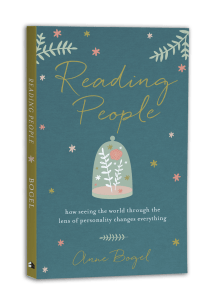
Book Review: Reading People

“I think I might be a highly sensitive person,” I told a close friend as we were prepping to co-work for the day.

She looked at me confused. “Uh, yeah. You didn’t know?”

I didn’t! I honestly didn’t until reading Anne Bogel’s new book Reading People. We’ll get to me in a moment. (Because I know that’s what you’re all dying to read about…) First, the book:

The subtitle, How Seeing the World Through the Lens of Personality Changes Everything, pretty much give you the rundown. As a longtime personality-nerd, I was fascinated to dig in and read what Anne, one of my favorite podcasters and bloggers had to say.

Each chapter captures the purpose and basics of the most popular personality frameworks out there including the Myers-Briggs Type Indicator, the Enneagram, Strengthsfinder, the 5 love languages, and more. Her goal is to help unpack why we behave the way we do and how to better understand the behavior and preferences of those around us. She often discusses understanding how these frameworks work together—a concept I never thought of. Once these lenses are no longer compartmentalized, you find a better vantage point from which to view the complexity of ourselves and those around us.

After reading her book, I understand why the Passion Conference was a miserable experience for me despite being a great time to learn. I know I’m not crazy for feeling anxious in a room filled with lots of people. I have better terms to describe why my first response to insecurity is to overcompensate. I also have a much better understanding of my friends and family members and feel better equipped to walk into moments of conflict.

Reading People is a great book for anyone trying to gain a deeper understanding of what makes them and those around them tick. Anne gives great tools and personal examples for digging deeper into these frameworks to engage in relationships better, be that marriage, friendships, parent-child dynamics, and even work place atmospheres.

You can pick up your copy here.

Leading a Romantic Life When You’re not in a Romance

One of the pleasures of seeking contentment in the season I’m in has been pursuing a romantic life over a life filled with romance.

What does that even mean? Great question!

My evenings are not filled with dates very often, but that does not mean that I need to wait to experience beautiful and exciting things—a thought-trap I think we can fall into when waiting for romantic love.

That’s a lie! Why wait to experience the beauty life has to offer until one is in a relationship?

I cannot tell you the joy I have found in visiting the local botanical gardens with just myself and a journal, in planning vacations with dear friends, in sitting in my favorite hotel lobby with a good book and cup of tea.

I live in a city that begs to be explored and while some of that exploration would be fun to do as a date night, why should I miss out when I find myself alone? Why should any of us.

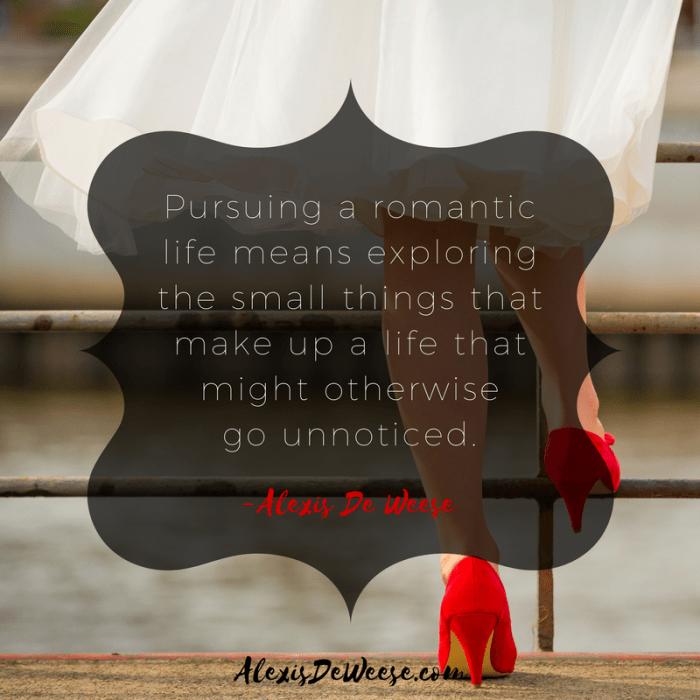
Pursuing a romantic life means making time for the things that bring me pleasure. It means stopping to enjoy created beauty. It’s exploring the small things that make up a life that might otherwise go unnoticed.

Here’s what this looks like for me:

    • Traveling Europe alongside close friends.
    • Spending an evening in with nothing to do but drink a cup of tea and listen to the poetry of a new record.
    • Taking myself on a coffee date.
    • Doing nothing but read for an entire weekend.
    • Bringing a journal to the local botanical gardens for a morning of prayer and reflection.
    • Driving hours just to go to see my favorite band play in concert.
    • Re-reading my favorite book from childhood each summer
    • Wearing heels and the brightest red lipstick I can find because it makes me feel like an old Hollywood actress.
    • Making last minute plans with a friend to talk about the real stuff over wine.

And it’s not just enjoying what I know I like, but pushing myself to experience the new and different, and maybe slightly uncomfortable. I have plans to take myself out to dinner. I’m starting to dream up a trip to take by myself.

Living a romantic life is participating, not in the life you dreamed of, but the pretty-damn-beautiful life you’ve been gifted. It’s taking note of the glorious and grand in the midst of the minute and mundane.

This has been my adventure and I want to hear about yours. How are you pursuing a romantic life?

Book Review: The Day The Angels Fell

I love YA literature even as an adult. Authors have freedom within the genre to do so much more than with books marketed for adults in most cases.

I don’t know if this is because the audience is more willing to suspend disbelief or more open to new ideas, but there’s more for a writer to play with that still has a greater chance of being published. That said, Christian fiction has been in a YA drought for a while.

I was worried that works like Lewis’ Chronicles of Narnia and L’Engle’s beautiful works were past us. Instead, there are romance primers for girls and next-to-nothing for boys and that’s been the case for many years now.

So imagine my relief and excitement when I heard about Shawn Smucker’s debut novel The Day The Angels Fell.
Smucker’s magical realism novel explores themes of death, good vs. evil, friendship and family. He tells the story of Sam, a twelve year old boy whose mother has just passed in a freak accident in his place. Immediately he decides that he must go on a quest to find the mysterious Tree of Life he’s heard from mysterious characters in town and his best friend, Abra, is along for the ride with him.

Smucker’s writing is clean and his voice is strong. I loved the images he colors his scenes with and his characters are complex and relatable. I was right along with him the whole way.

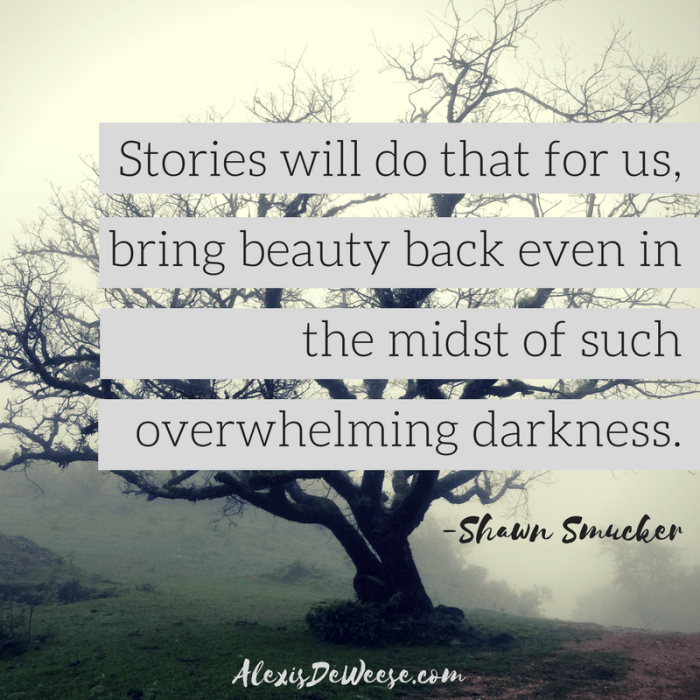
I often find that contemporary childrens and young adult literature in CBA gets quite preachy or at least harps on the “moral” far too much, but this is not an issue with Smucker’s novel. His themes are clear, but have such a depth. He trusts his audience and I think that will be appreciated by young readers and adults. He—and his characters, for that matter—don’t talk down to the reader. He’s pacing alongside the whole while with some truly profound insights tucked naturally within the story. I was often sent racing from the couch for a pen to underline some absolute gems. (See the meme below!)

I would recommend The Day the Angels Fell to fans of Neil Gaiman’s The Ocean at the End of the Lane and L’Engle’s a Wrinkle in Time.  At turns dark and others heartwarming, Smucker’s world is original, heart-wrenching, and profound.

Pick up your copy here!