Blog

Friday Favorites: March 2016

photo-1431608660976-4fe5bcc2112c

So I am aware that today is April, but like a fool (see what I did there), I totally forgot to publish this last Friday…And you can’t post a Friday Favorites post on any other day. That’d be weird.

So March was reading month and I took advantage of it to take some books off my reading list and add some to it. Here is the fruit of that labor:

1. A Prayer Journal—Flannery O’Connor

Flannery is way out of my league, but if you want a mentor on the written word through the written word, she’s the way to go.
For Christmas, my sister had picked up my subtle* hint that I wanted a copy of the short story master’s prayer journal and I’m so thankful she did.
O’Connor shows beautiful vulnerability and insecurities that are easily echoed by so many writers. I read this in one sitting and loved it.
*By subtle, I mean I sent an email with accompanying Amazon links. I’m smooth like that.

2. Me Before You—Jojo Moyes

I am not a romance fan, but I love a good love story…and a candy read in the airport. I’m headed to Austin in a few days and wanted something simple and fun for the travel. I started this a couple days ago and think this will really fit the travel bill.
I would also like to say that I am bringing along a favorite literary journal to save face among the Austin hipster set…

3. Restless—Jennie Allen

I bought this book a while back to read with a friend for two reasons: 1.) The title said it all when it came to what we were feeling in our opposite life stages and 2.) The internal design is really great*.
…But then we got too busy between her two kids and my unpredictable work life to actually read the book together. I dusted it off earlier this month and have appreciated what I’ve gleaned so far.
*Maybe you shouldn’t judge a book by its cover, but you can judge it by the internal design. And who are we kidding—you can totally judge a book by its cover!

4. The Dark Sea of Darkness—Andrew Peterson

The title says it all.
…And if the title doesn’t say it all, here’s a little more: This is the first book in the Wingfeather Saga by Andrew Peterson (who is also a musician). It’s a fabulous children’s series and a modern classic. It features quirky creatures and great dialogue and a completely original world. And who doesn’t need a good middle-grade read?…as a mid-twenty something…don’t judge. You know this is the one recommendation on this list that interests you the most.

5. On Beauty—Zadie Smith

I’m attending the Festival of Faith and Writing later this month at Calvin College*. Zadie Smith is one of the key note speakers. I found this book at a fantastic bookshop in Battle Creek a couple weekends ago and am hoping to polish off this novel before the conference. It’s a little more arty than I tend toward, but I’ve often felt that way about books I’ve picked up at the festival and they’ve always ended up being some of my favorites.
*No, I don’t get a pay raise for mentioning them…that’d be nice though…I think the blog might take an unfortunate tangent for a while…

What books have pulled you through the month of March? Any recommendations I should keep an eye out for? I’d love to hear about them in the comments below.

Social Culture Shock

bb9f9777
In the being back on social in the last couple months, I’ve been asked if it is weird using it again.

Answer? YES! And at the same time no.

No because I was using it for work on hiatus. It’s not like I forgot how to use Twitter. (I may have had to look up videos on Snapchat like a 60 year old…it changed a lot in a year, okay?)

Yes because, well, it’s kind of intrusive.

In my first week back on the grid, I tried to catch up on messages that had accumulated over the year. I commented on a post a friend had tagged me in while I was messaging. As soon as I responded, there was a response back and then responses from others.

My introverted brain began to hyperventilate slightly. I loved these people, but I was a little taken aback by the rapid nature of the communication. I was doing this in my quiet time—my recharge time. Suddenly it felt like the world was infringing on that.

I had to get off, take a break, not be there. It felt like culture shock.

In my time away from social media, I noticed that I had to work harder to connect with friends and loved ones. I had to make more of an effort. Obviously, it was worth the effort.

I also found that having boundaries on my social time was valuable. In my time back in the digital social sphere, I have found that I am still bad at respecting those boundaries. There is a balance between being connected and being over-connected.

I’ll be honest, I’m not great at finding a balance in things. When I’m in something, I’m all in—not always a bad thing, but I was seeing some bad consequences connected to my social media usage.

Coming back to this, I having to learn how to balance. Taking yourself out of the equation completely—not exactly balanced.

As a culture, we’re terrible at maintaining boundaries and I am just a product of the culture. Being in constant connection with each other doesn’t really lends itself to boundaries easily and I’m wading into that tension.

As a people-appreciating introvert, I know that I need space to recharge, but I can easily ignore that need. Maneuvering the culture shock of social media, I’m seeing the importance of respecting my own boundaries and limits.

So yes, the temptation to run away again is definitely there. But along side it is a desire to find balance. I know I can write and recharge and build a platform. It’s a balancing act and in it, I’m discovering the multiple meanings of grace.

Three Unfinished Poems

photo-1455390582262-044cdead277a

Part of my purpose in keeping this blog is to document some writing samples. I want to approach some prompts and preset some works-in-progress just to get comfortable putting my work out there…and hopefully one day in journals.

My goal is to have a different sample up every month. This month, I have three poems I’ve been wrestling with over the past month.

This is where we start practicing vulnerability. I’m not a poet, but these vignettes weren’t manifesting themselves as short stories…one of them isn’t really manifesting itself as a poem well either and is probably actually an essay, but I’m a firm believer in the rule of three.

October

Walking, the autumn sun was uncharacteristically warm in the contrast
of your lanky shadow draped across me like a dad-borrowed blazer on
my shoulders, eagerly placed on the walk home from a jr. high dance.
We, in the moment, too pleased with our luck of being away from your
meathead friends and chaperone eyes, to notice the inelegance of us.

My rib cage filled with cotton balls, the lightness rotating inside me with
each step, as I hopscotched your long leg lines across the graveled path.
You seemed to glide, tall and erect, as I wallowed in the thirteen year-old
feeling wondering if I wanted to hold your hands. They had carried a lot
since your gym dance days and mine had been too open to carry anything.

Judging whether it’s still appropriate to arrange for my best friend to give
Your best friend a note: Check yes or no—because maybe we had something
right at thirteen. Maybe we were supposed to risk, to ask and fail rather than
rehearse the fall once the leaves cleared. The walk feels cold without your
shadow-jacket on my shoulders, the note in the pocket check-marked “or.”

Screen door poem II

The screen door slap was the exclamation point to our fragment.
My wineglass rattled, straddling the uneven slats of the rough table
And my eyes blinked as the slam-noise silenced my rolling brain.

Tracing the knots of the table wood, I try to trace where we started,
where we turned to end up with your chair flat on its back and my
napkin wet with mascara. Out of breath, I blot and blink on the cotton.

Blink in surprise that you’d leave when the results returned negative,
blink in prayer the door spring-echoing open would bring you back in,
blinked in relief that I wouldn’t have to follow through at your side.

But I sit here still—now in the royal blue dark, the wine glass gulped dry.
And I can’t bring myself to admit I’m wrong when hurt sits across in the
upturned chair, our statement unresolved—like an em dash waiting for—

Wisdom Lost

I have never been more aware of the gaping holes in my head, like
the clam whose pearls were stolen, drawn to aching openness—
air split across the hole making ache rather than lilt of fife-tweets.
High tide and the world flattened to echoing sonar in the dark.

Necessary entrance, but hesitant and unwanted attention chancing
the hopeful irritant, the salt of sand makes naught of pearl-value.
The puss of a gape-hole left to fester with the constant tongue push.
Fog does clear, world tilting open to find blood, gauze, and nothing.

Fitzgerald and the Wish-Dream

photo-1457369804613-52c61a468e7d
I have been auditing a class this semester as 1) a trial-run for a masters program and 2) a new outlet to chase my obsession with the expatriate modernist writers. It’s a class centered on American lit from the reconstruction period up to the start of World War II.

Since I’m auditing, I don’t have to do the class work outside of the readings. As such, I don’t get to write the papers (because I’m that person.) While reading The Great Gatsby this past week, I’ve had some musings that may not be totally up your alley, but I have a point. Trust me, I do.

In reading the book for the third time, I have to say it is a pretty damn near perfect novel. If you have not read Fitzgerald’s bird-flip to the jazz age, I highly recommend it. (March is national reading month, after all.)

The descriptions, the symbolism, the balance, the prophetic nature—the heaviness of graceful prose. I cannot wax enough.

What really strikes me though is his grasp on reality in the midst of what could be. He gives it all away on the second page of the novel:

No—Gatsby turned out all right at the end; it is what preyed on Gatsby, what foul dust floated in the wake of his dreams that temporarily closed out my interest in the abortive sorrows and short winded elations of men.

This is his thesis. This dust in the wake of dream—it’s what each of the characters are caught up in. It’s what Fitzgerald is finding himself surrounded by. It’s where many of us find our lives headed.

You see, Gatsby—and I believe Fitzgerald to an extent—was chasing a wish-dream. The novel rides the tension of the fantasy Gatsby has created to live in reality and the reality that cannot keep the fantasy alive.

I think Fitzgerald was exploring if the wish-dream of his time. Was avoiding the heavy despair of the war with the gayety and whimsy of the twenties sustainable? Could the party and the money and the booze last forever without consequence?

But we all know what goes up must do something.

The characters are all avoiding consequence in one capacity or another. They run from mourning, or refuse to accept loss, or simply just want to think of nothing but their own pleasure for however long they can. Fitzgerald chases his suspicion that this cannot be maintained.

Gatsby was published in 1925, four years before the stock market crash—before the roaring twenties came to a roaring halt. But the novel was written like he knew all along.

Because we all know that when we avoid the heaviness, when we cover our brokenness, when we never take the chance to mourn, that it all begins to come crashing in. The wish-dream is not all it appears to be and by avoiding consequences, new ones emerge.

To embrace when we’ve lost, to accept what is, rather than trying to continually rev the engine of our car despite the missing wheel—it’s necessary. It’s hard by healthy.

In this life, we do not get the dream. We do get a chance to embrace what is in front of us with grace and courage. We get the chance to risk in what is, rather than hide in what could be. And as I believe Fitzgerald realized too late, we are the better for accepting that.

As Fitzgerald mourns a lack of nobility in his world, we can find that that kind of courage is still available to us. But are we willing to accept was is?

Living Life by the Word Count

photo-1434030216411-0b793f4b4173It is with great shame that I confess that I have been working on the same novel for seven years.

It’s not that it’s really taken seven years to write, I’ve just taken my own sweet time with it. And granted, within those seven years, I’ve completed high school, began and completed an undergrad, started a business, gave up on said business, joined forces with a friend’s business, got a practically full-time job to supplement my work with the business, moved a couple times…

I really can go on with my excuses.

But I got sick of the excuses and really have figured it’s almost time for a year of jubilee. I am ready to be freed from this project.

I still love what I’m working on, but it’s just time for these characters to have their story in total and for me to move on.

So this is the year. This novel will be written.

But how?

By keeping a word count.

I’ve blogged a couple times about writing in community and I cannot emphasize enough how grateful I am for those I get to do my work beside. and I’m so grateful for the small team helping me complete this novel. Because it does take a village some times.

At the start of this year, I decided I needed to have some skin in the game and get this book done. I have two close writing partners who will be holding me accountable this year. My goal is to have the draft completed by November 23, 2016. If it’s not done by then, I owe them each $25.

MyNovel timeline-Should I need an extension, I will be taking them both out to dinner in which I’ll need to spend the complete $50.

So that’s my “punishment” but how do I avoid having to pay it?

By sticking to a word count. I have committed to writing 1,500 words a week until June, when the word count will grow. I have three times in my week designated for writing. I am not allowed to leave the manuscript until my 500 words are written in each session.

It’s hard. Sometimes that 1,500 mark is a struggle. Sometimes I get only shit writing out of it. Sometimes there are plot holes, but I need to just keep moving and save them for the editing process. Sometimes I don’t make the goal.

But the goal stands none the less. And I’m encouraged week in and week out whether I make it our not.

The word count rules the day right now and there is fruit coming from the labor.

Have you set a word count for yourself? How do you motivate yourself to stick to it?

Finding your WHY

doctype-hi-resWhen I tell people I work in marketing, I never really know what response I’m going to get. “Platform building” is not always everyone’s favorite topic. To many, it feels disingenuous, or even a little slimy and I get it. Trust me. I get it.

The thing is, I’m not just promoting things for the money. I get to market books and education—two things I’m very passionate about. I don’t feel like I’m selling something unnecessarily. I’m recommending things I can stand firmly behind and I just happen to get paid for it.

If I don’t believe in what I’m promoting, is there really any point?

For authors opposed to building their own platform, I think a shift in perspective may need to be considered. The question to be answered is how are you actually viewing platform? Is a platform something

A.)used to sell books

or is it B.)a tool to build relationships and foster discussion?

I firmly believe option B is what makes a platform. A just alienates those who believe in your work and doesn’t draw anyone new in.

So what’s the difference between the two?

It all boils down to your WHY.

Simon Sinek explained the concept in his 2009 Ted Talk, which I highly recommend. People don’t buy what you do, they buy why you do it.

Marketing doesn’t work if it’s just advertising. It’s a relationship. An exchange of values and ideas that may result in a product. But it may not. This is what separates the schmoozing from the substantial. An author’s platform is not meant to be shameless self-promotion. It’s supposed to be tribe building.

I could talk about this all day, but if you’re looking for more on this topic, I recommend this blog post I wrote for Apricot Services.

Weigh in in the comment’s section. What turns you off to marketing and what does platform building look like to you?


Friday Favorites: February 2016

unsplash_525f012329589_1I’ve accumulated a year full of awesome favorites and I’m so excited to unroll them with you over the next year. So here’s how Friday Favorites are going to work from here on out:

Each month I will be highlighting something to try, something to click, something to read, something to watch, and something to listen to.

Now, without further ado, I give you:

February 2016

Something to try: Less screen time

The year is still young and new starts are always encouraged. Here’s what I’m encouraging you to try this month. For one hour each week for the next month, I want to challenge you to turn off your phone.
Seriously.
Turn it off. Leave it in your purse. In another room. Just. Walk. Away.
And go have a conversation with someone. Like a real person. Or read a book. Like with physical pages and a binding.
Really, just do something without a screen. Except maybe microwaving. Microwaving usually leads to the heating of things like doughnuts. Yes. Turn off your phone and heat up a doughnut.

Something to click: Rifle Paper Co.

Looking for a great calendar or stationary?
Rifle Paper Co. has such adorably designed products. Seriously, I can’t get over their stuff.

https://riflepaperco.com/shop/calendars/2016-alice-in-wonderland-calendar/
A page from their 2016 Alice in Wonderland calendar

Something to read: Arts & Entertainments—Christopher Beha

ArtsEntertainment-pb-cI heard Christopher Beha speak at the Festival of Faith and Writing in 2014. He is an extremely thoughtful writer who may just be our generations answer to Flannery O’Conner.
Arts & Entertainments starts as a realistic fiction novel revolving around failed actor Eddie Hartley, who is now a high school drama teacher. Eddie and his wife struggle to have a child. To afford fertility treatments on a high school teacher salary, Eddie sells a sex tape of him and ex-girlfriend-turned-hollywood-starlet.
The fall out is an incredible satirical ride that ends up holding a mirror to the reader’s world. By the end, it feels like a dystopian novel in the best way possible.
Unnerving and unputdownable. (It’s a word.)

Something to watch: Suits

The great Suits mid-season cliffhanger is about to be relieved!!!!
In the meantime, share a great moment with Donna and Harvey.
http://www.youtube.com/watch?v=UJRW6bTmJrk

Something to listen to: Penny and Sparrow

This is by far the one I’m most excited to share this month. This duo opened for Drew Holcomb and I kind of liked them more than the act I payed to see. Beautiful lyrics, great composition, and fantastic stage presence. Seriously. These guys are hilarious…despite what their heavy lyrics would lead you to believe.

Anything by them is worth a listen. So rich. So good.

Being present

photo-1431069767777-c37892aa0a07Instagram is the platform I’ve decided to stick with post-hiatus. It’s simple and visual and doesn’t take up too much of my time.

That said, I think our image-driven culture has created a new philosophical dilemma. Namely:

If a girl goes to a thing but doesn’t photograph it, was she really there?

I didn’t really think about it until I was at my first concert while on hiatus. And I enjoyed the whole thing. Including my favorite song.

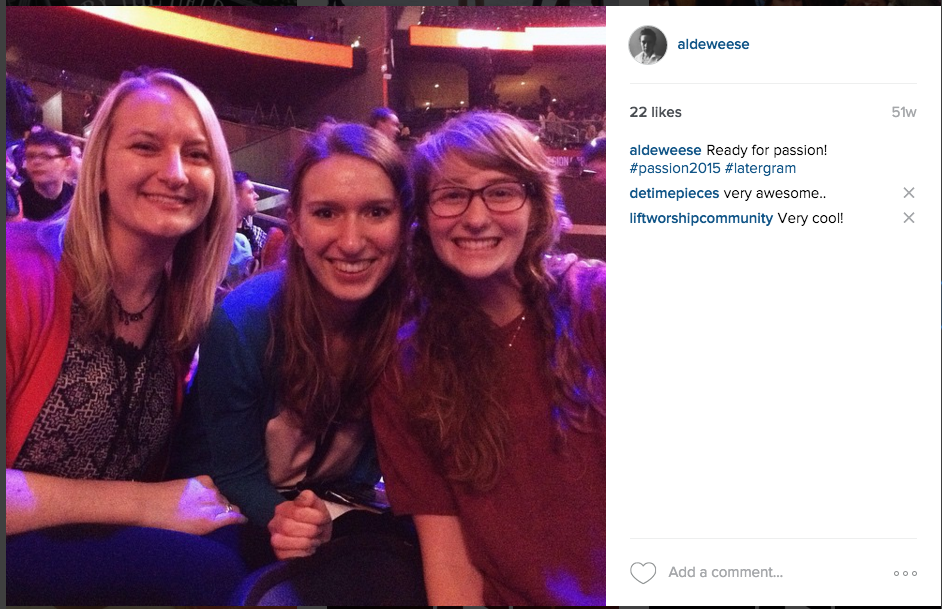
Usually, attending a concert would be a huge social marketing undertaking in promoting myself and the fact that I would be present and whatever event.

There is the bought-the-“tix”-shot. (Seriously. “Tix.”)


And then the waiting-for-the-event-to-start-selfie…which actually does serve a purpose because what else are you going to do while you’re waiting? Conversing can be difficult in loud venues and selfies take no words!…
Screen Shot 2015-12-28 at 10.44.51 PM
And finally the during-the-event photo or video. If you’re at a concert, video is expected, though possibly frowned upon by both copyright and the poor person trying to enjoy the concert behind you. But you have to capture your favorite song because if you don’t, is it really your favorite?!?!?!?!?

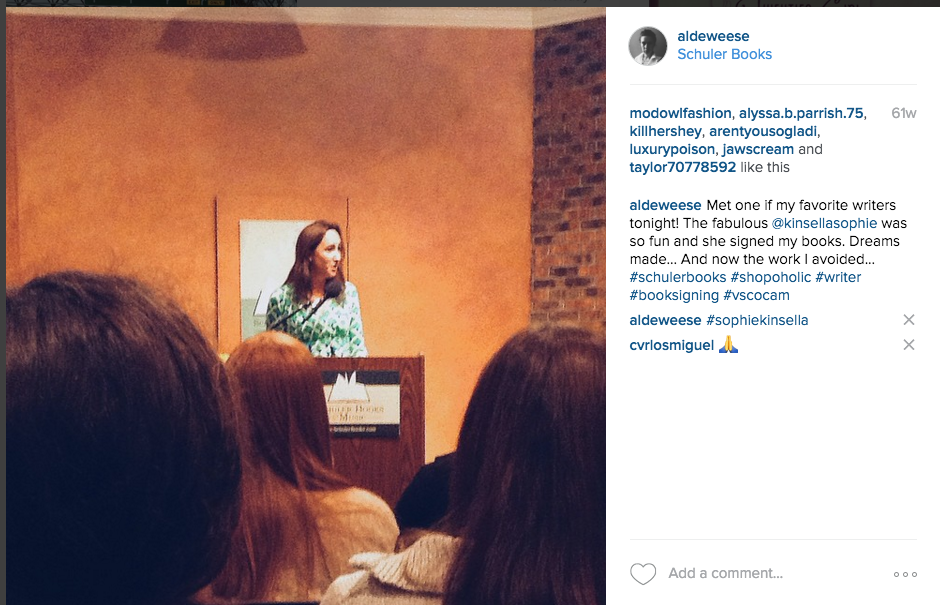
This is from a book signing, but same concept at play here...
This is from a book signing, but same concept at play here…

At this first hiatus concert, the artist started playing my favorite song and I got to really take in the moment. There wasn’t the mad grab for my bag during the intro and the struggle to get a good shot around that jerk in front with his selfie stick. No. While everyone around me was doing that, I was enjoying a song I loved with the artist right there playing right then. There was no screen between him and I. Just good music.

Because what is the point of going to a show if you’re going to spend it on your phone? You could see hours of that on YouTube. And are you going to tell me you’re actually going to excitedly sit down to watch that concert back with poor audio on that tiny screen? And I don’t care what improvements Apple makes to video, it’s still not going to be the same.

Don’t miss the moment because you are trying to capture it. Take it in. Savor it. Let it go.  I promise, it makes the special moments that much richer.

When You’ve Failed Yourself

photo-1429051781835-9f2c0a9df6e4I’ll be the first to admit that I have not written nearly as much as I would have liked to in the past year. New and more hectic life rhythms, a maddening case of writers block, more pressing writing projects—oh don’t worry, I’ve had excuses.

I just thought I’d be closer to finished with this novel than I am.

I can go ’round and ’round beating myself up, but that doesn’t put more words on the page. Actually, I found it was making it worse. I would berate myself for not making the time or procrastinating when I had the time. Once I was actually writing, I would be extra critical of what I had put down.

I was getting no where.

When you have failed yourself, it’s so easy to retreat further and further into yourself. It’s easy to avoid the tension or the vulnerability by just not doing. And that’s where I was at.

I had to learn to fight not only for myself, but for my work. And I had to fight dirty. This was not a chance to give up. This was a chance to power up.

My previous process had me doing light edits as I went. When I was producing lots of work at a quick rate, that worked well. I was able to clean enough as I went to not have to do heavy lifting during the actual editing process.

Once I was not producing chapters very quickly, it became difficult to ignore some things and easy to just skip straight to heavy edits. I was bogged down and nothing was good enough.

I had to learn to be okay with the mess. To promise myself I could sit down and fix it—but later. I just had to put my head down and keep rolling.

I also had to force myself to write.

There’s a saying that returning to a creative project after a while is like entering a cage with a lion. You need to climb inside and tame the animal. The more often you do it, the less intimidating it will be. The less often you do it, the more scared you will be.

In the process of beating myself up, I had begun to avoid my work. I finally had to suck it up and climb in the den to tame the beast. I had to sit myself down in a chair and make myself write 200 words before I could leave. Slowly, I was able to up that word count until I no longer had to force myself.

When you’ve failed yourself, it seems so easy to give into the failure altogether. But this is a battle cry, my friend! You may have failed yourself yesterday, but today is a new day. It’s time to pick up and carry on.

New Address

photo-1446475157725-e6dada23994eMaybe you noticed, maybe you didn’t, but I’m not located in Bohemia anymore. And my name isn’t “Lex from Bohemia.” I mean, it is Lex. But I do have a last name. Postcards from Preppy Bohemia was a title I loved for my blog, but if someone was looking for my writing, they were not going to find it under my name.

I have one piece of digital marketing advice for anyone looking to start their own platform:
If you’re going to put content somewhere on the interwebs, put your name on it.

For our tech-free folks, the domain is the URL (web address) for your site. It’s how people find your blog/site/store/whatever. If your name isn’t on it, people aren’t going to find it.

One of the best blog posts I’ve read in the past year is from Chad R. Allen (who has a great blog for anybody interested in Christian publishing, by the way.) on how he as an editor interacts with platform right off the bat. He discusses how he will google a writer’s name when he encounters their book proposal.

When I Google a writer’s name, what I hope to see at the top of the search results is the author’s blog or website. This tells me the author has an established location online that Google’s search engine considers worthy of top billing.

See, part of the publishing game is marketing. A lot of getting a book published is letting people know it’s out there. If you don’t have a platform, editors are more likely to move on because they are not willing to put in effort if you have not put in the effort.

The problem is, if you’re name isn’t on the platform you’ve built, how are editors or even readers going to find your work?

So I figured it was time I started practicing what I was preaching.

Welcome to AlexisDeWeese.com! I may not have top billing on google yet, but with some SEO work, we’ll get there. I’m excited to have the new site up and rolling. Pardon the dust as new features emerge.

Don’t forget to leave a comment and share with your friends!

New Address Graphic